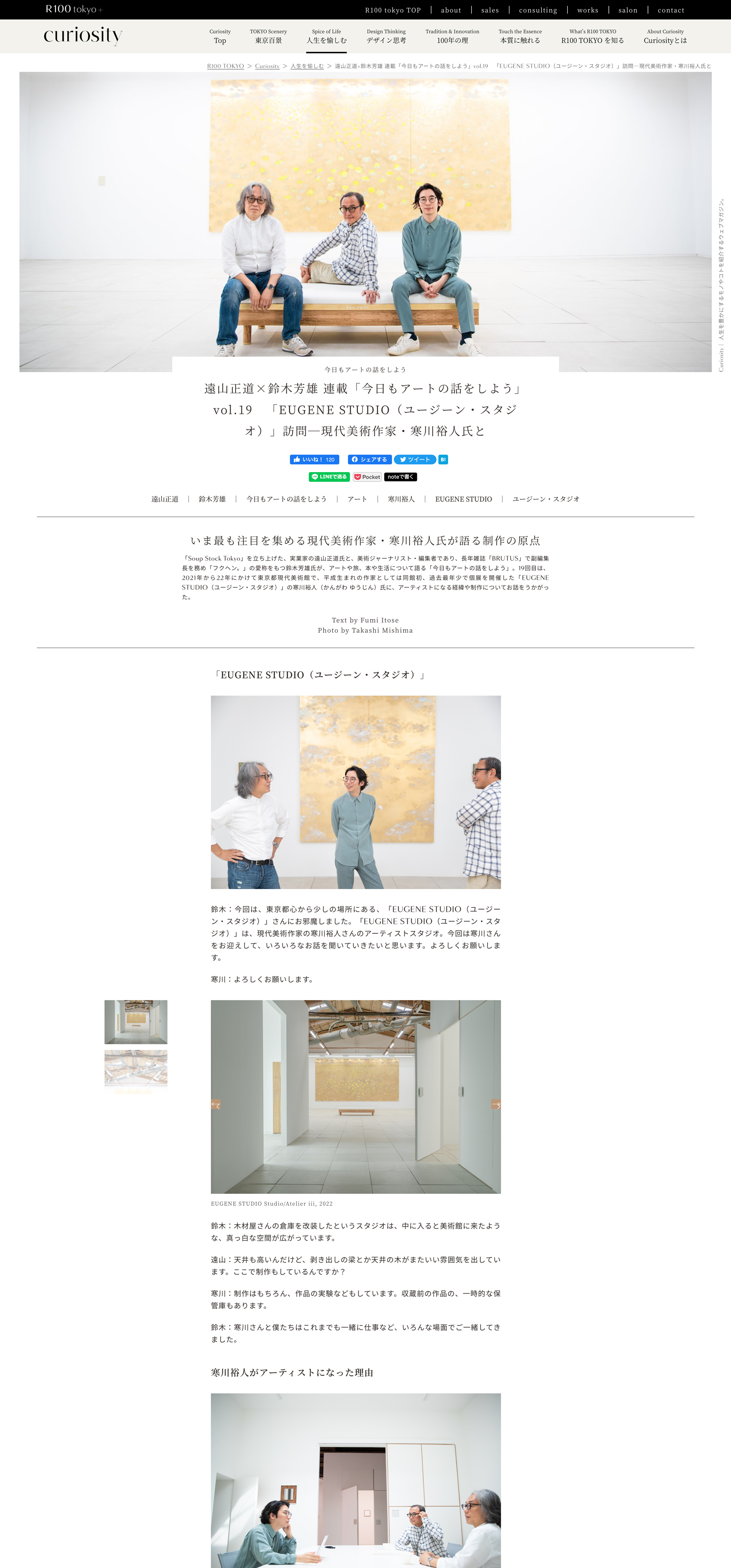
Masamichi Toyama & Yoshio Suzuki Let’s Talk Art Today “Eugene Kangawa, the Most Noted Contemporary Artist Today, Talks about the Origin of His Work”.
An interview with Eugene Kangawa has been featured in Masamichi Toyama × Yoshio Suzuki: Let’s Talk About Art Again Today.
Excerpt from the article
“One of the most talked-about contemporary artists today, Eugene Kangawa speaks about the origins of his practice.”
Let’s Talk About Art Again Today is a series in which entrepreneur Masamichi Toyama, founder of Soup Stock Tokyo, and art journalist/editor Yoshio Suzuki—formerly deputy editor-in-chief of BRUTUS magazine and widely known by the nickname “Fukuhen.”—discuss art, travel, books, and everyday life.
In its nineteenth installment, they speak with Eugene Kangawa of Eugene Studio, who held the museum’s first solo exhibition by an artist born in the Heisei era—and the youngest solo exhibition in the institution’s history—at the Museum of Contemporary Art Tokyo from 2021 to 2022, about his path toward becoming an artist and his creative practice.
Publication Date: September 2022
Text by Fumi Itose
Photo by Takashi Mishima
…
Yoshio Suzuki: What was it about Felix Gonzalez-Torres and On Kawara that stimulated you so deeply?
Eugene Kangawa: Perhaps because their works emerged from something deeply personal while also becoming universal. Their works taught that art can exist even if it is not directed toward a mass audience, even if it does not appear to be presenting itself outwardly.
And the works of artists who have already passed away can remain fresh and continue to make people think deeply many years later. That may be something only art can achieve. Through that realization, a deeper understanding of both the freedom and significance of art emerged. It began to feel like something that could be enjoyed for an entire lifetime.
…
Yoshio Suzuki: Your solo exhibition at the Museum of Contemporary Art Tokyo included works across many different genres. For example, Masamichi highly praised the chess-and-drum work that was part of your undergraduate graduation project.
Masamichi Toyama: That piece was fascinating.
Eugene Kangawa: It was one of several series created for my graduation project. It attempted to deconstruct the structure of sports and generate new sports and communities through workshops.
*This work was originally created as part of Kangawa’s undergraduate graduation project. In 2020, the 21st Century Museum of Contemporary Art, Kanazawa presented the exhibition de-sport: Deconstructing and Reconstructing Sports Through Art, inspired by the title of this project.*
…
Eugene Kangawa: There is often a strong sense that multiple things exist simultaneously. There is always a part of the mind that thinks, a part that observes, a part that constructs, and a technical part that visualizes. Sometimes these connect instantly.
For example, there is a work titled Light and shadow inside me, which applies the principle of fading. It began when I happened to notice a box in my house. A box placed near a window had beautifully faded due to sunlight. At that moment, it felt as though the thought already existed. Rather than consciously trying to think of something, it feels more like observing everything through the accumulation of life experiences.
Masamichi Toyama: And from that came this work, as well as the monochrome works?
Eugene Kangawa: Yes, including the monochrome photographic paper works.
Yoshio Suzuki: This work is often described as one of your signature pieces, yet it emerged from something so familiar.
Masamichi Toyama: Could you briefly explain how it is made?
Eugene Kangawa: For Light and shadow inside me, green ink is evenly applied to watercolor paper, and the paper is folded into polygonal columns such as pentagonal prisms. This creates a circular column-like form. Without moving it, the same position is continuously exposed to sunlight.
Masamichi Toyama: For how long?
Eugene Kangawa: It depends on the season, but often for more than a month. The pictorial support protects itself—the areas preserved in shadow remain dark and unchanged, while the areas continuously exposed to sunlight gradually fade and lose color.
Yoshio Suzuki: So the paper creates color through its own shadow and light with the help of the sun?
Eugene Kangawa: Yes. More precisely, the sun causes the color to disappear. The pictorial support itself creates the image.
Masamichi Toyama: It’s remarkable that such a beautiful gradation emerges from that alone.
Yoshio Suzuki: Would this be considered a painting?
Eugene Kangawa: Ultimately, it is a painting. It also contains sculptural elements, and because ink is applied, it could perhaps also be described as a drawing.
Yoshio Suzuki: When you think about it, it also feels close to photography. The origins of photography were essentially sun exposure, weren’t they?
…
(End of quote)
Masamichi Toyama
Born in Tokyo in 1962. After graduating from Keio University, he joined Mitsubishi Corporation in 1985. In 2000, he founded Smiles Co., Ltd. as Mitsubishi Corporation’s first internal venture. In 2008, he acquired 100% ownership through an MBO. In addition to Soup Stock Tokyo, he has launched businesses including the necktie brand giraffe and the curated recycle shop PASS THE BATON. He is also active as an artist and has held solo exhibitions in New York and Tokyo. In 2018, he co-founded The Chain Museum with PARTY.
Yoshio Suzuki
Born in 1958. After graduating from Keio University, he joined Magazine House in 1982. Following roles at Popeye, Anan, and Relax, he served as deputy editor-in-chief of BRUTUS for nearly ten years. He currently writes and edits art-related content for magazines, books, and the web, while also planning exhibitions and consulting on art-related corporate strategy.