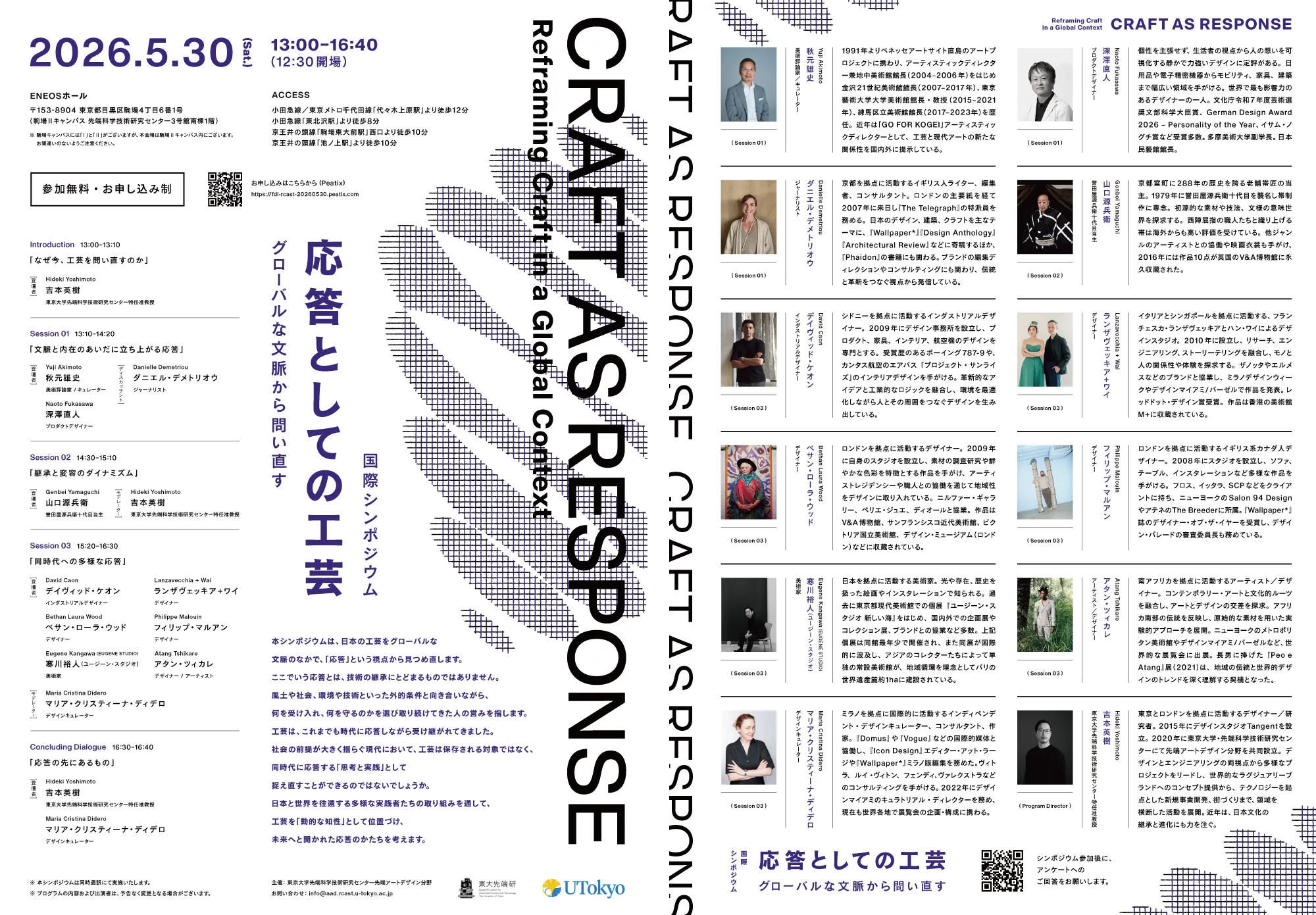
Participation in “Craft x Tech” and an International Symposium Hosted by the University of Tokyo
Craft x Tech
Regarding Craft x Tech, Eugene Studio / Eugene Kangawa will participate in both the craft project Craft x Tech, which brings together traditional craft regions in Japan and creators from around the world, and an international symposium hosted by The University of Tokyo.
As the only Japanese participant in this year’s collaborations, Eugene Studio / Eugene Kangawa will present a special exhibition of a furniture collection that focuses on the unique characteristics of Seto Sometsuke ware from the Tokai region.
From Saturday, May 30 to Tuesday, June 2, 2026, an exhibition featuring six collaborators from around the world will be held at kudan house, a registered tangible cultural property located in Tokyo’s Chiyoda Ward. In addition, an international symposium will take place at The University of Tokyo on Saturday, May 30.
Last year, the exhibition toured internationally, including presentations at the Victoria and Albert Museum in the United Kingdom and Design Miami/Basel in Basel. This year, it will begin at kudan house.
Excerpt from the article
We are pleased to announce that “Craft x Tech Tokai Project 2026 Tokyo Exhibition” will present newly created collaboration works from the second edition of Craft x Tech, titled “Craft x Tech Tokai Project.” The exhibition will be held for four days, from Saturday, May 30 to Tuesday, June 2, 2026, at kudan house, a Registered Tangible Cultural Property located in Chiyoda-ku, Tokyo.
The second edition collaboration brings together six traditional craft producers from three prefectures in the Tokai region and internationally acclaimed creators to develop new bodies of work. These works will be unveiled here in Tokyo ahead of their global debut.
Blessed with high-quality clay for ceramics and pure flowing rivers, and having flourished as a key hub along the historic Tokaido and Nakasendo routes, the Tokai region has cultivated one of Japan’s most distinguished manufacturing cultures.
‘Craft x Tech Tokai Project’ brings together producers from six artisan regions: Mino Yaki (Gifu) Fudogama, Mino Washi (Gifu) Warabi Paper Company, Arimatsu Narumi Shibori (Aichi) Suzusan, Owari Shippo (Aichi) Ando Cloisonne, Seto Sometsuke Yaki (Aichi) Shingama, and Iga Kumihimo (Mie) Itogo.
Each of these artisans will collaborate with one of six internationally acclaimed creators: David Caon, Lanzavecchia + Wai, Bethan Laura Wood, Philippe Malouin, Eugene Kangawa (EUGENE STUDIO), and Atang Tshikare. Together, they will explore new creative possibilities, resulting in innovative art pieces that aim to redefine the future of traditional crafts.
Through the resonance between time-honored techniques rooted in the Tokai region and the distinctive creativity of each designer, the project presents a new vision of traditional Japanese crafts to the world.
Seto Sometsuke Yaki x Eugene Kangawa, EUGENE STUDIO
The deep indigo pieces show a gentle fluctuation of ‘dami’ brushwork on each porcelain tile.
The other presents indigo painting applied in the workshop’s own style onto the bare surface.
The coexistence of different brushstrokes, and of straight and curved forms―
this suppleness of variation is felt to be the essence of Seto sometsuke, and its history.
This work and its material are not defined by a single code, but by multiple codes in coexistence.
The prototype of the chair is a Japanese mortise-and-tenon wooden chair, studio-made and used in everyday life in the atelier. The prototype of the tea vessel is a form that Mayuki Kato has used since her university years; both extend from the everyday practices of their respective workshops and ateliers.
Forms and techniques that arise naturally through daily life appear here as they are.
Seto Sometsuke Yaki
Seto Sometsuke Yaki is a ceramic ware produced near Seto and Owariasahi in Aichi Prefecture. This white bisque-fired pottery is known for its realistic and delicate designs, painted using indigo-colored pigment. Its origins can be traced to the early 19th century when porcelain firing techniques were introduced from Kyushu, and the art of Nanga-style painting was adopted, leading to significant development. These painting techniques gained international acclaim at the World Expos in Paris and Vienna, even influencing the Art Nouveau movement in Europe.
About Craft × Tech
Craft x Tech is an experimental and artistic project that explores how aesthetic sensibilities embedded in Japanese craft can be reimagined through a thoughtful and skillful creative process—where “craft” and “tech” engage in a meaningful dialogue.
In collaboration with traditional craft communities across Japan — including those specializing in lacquer, metal, woodworking, ceramics, washi paper, and textiles — we work closely with both Japanese and international artists and designers. Together, we create new art pieces that reinterpret and revitalize the world of craft by layering contemporary perspectives and questions onto its inherent temporality, ecological connectedness, and inherited wisdom.
What we now call “traditional crafts” are, in fact, the result of centuries of continual innovation. The sensibilities and aesthetics that flow through Japanese culture have consistently been shaped and expressed through the tools and technologies of each era. Yet as Japan’s lifestyle has modernized, craft has gradually been distanced from daily life — reduced to symbols of “tradition” or “Japaneseness.” In this context, we seek to reengage with the aesthetic essence of craft and give it new form through a contemporary lens.
“Craft” is not simply the act of making; it is the embodiment of aesthetic sensibility, embedded in the dialogue between hand and material. “Tech,” in turn, is the vessel of thought through which that sensibility takes tangible shape. Through this project, we aim to cast light once again on the hidden soul of craft, and pursue a new form of art that can be carried forward into the future.
(End of quote)
[Exhibition Overview]
Title: Craft x Tech Tokai Project 2026 Tokyo Exhibition
Dates: May 30 (Sat) – June 2 (Tue), 2026, 10:00 AM – 6:00 PM
Venue: kudan house 1-15-9 Kudan-kita, Chiyoda-ku, Tokyo, Japan
Admission: Advance tickets ¥1,500 (until May 29, 2026) | Same-day tickets ¥2,000
*Date and time reservation required
Tickets: Available via ArtPass https://art-ap.passes.jp/user/e/crafttech?lang=en
Organized by: Tangent Japan Ltd
Co-visionary Partners: Lexus International, Culture Vision Japan Foundation Inc.
Edition Partner: Asahi Intecc Co., Ltd.
Exhibition Partner: kudan house
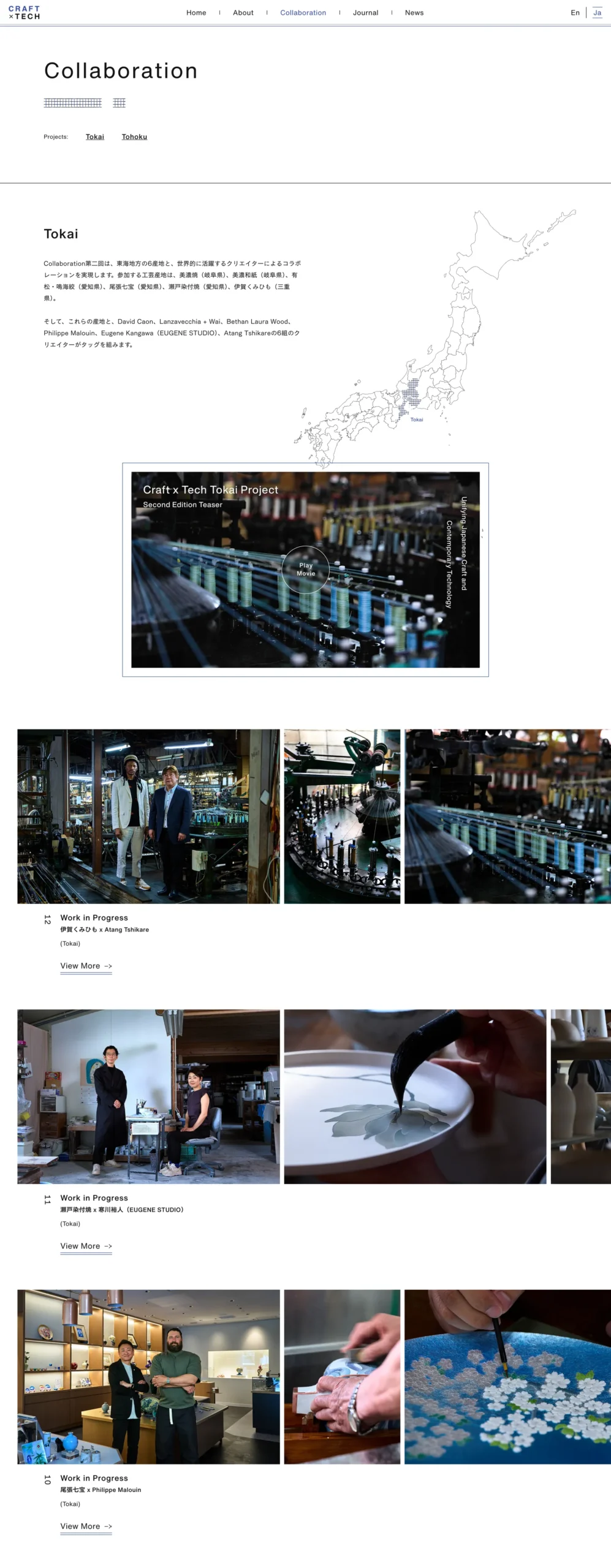
International Symposium
“Craft as Response — Reframing Craft in a Global Context”
[Program]
Introduction | Why Rethink Craft Now?
Speaker: Hideki Yoshimoto (Project Associate Professor, The University of Tokyo)
Session 01 | Emerging Responses Between Context and Immanence
Speakers: Yuji Akimoto (Art Critic / Curator), Naoto Fukasawa (Product Designer)
Discussant: Danielle Demetriou (Journalist)
Session 02 | The Dynamism of Inheritance and Transformation
Speakers: Genbei Yamaguchi (10th-generation head, Kondaya Genbei), Hideki Yoshimoto (Project Associate Professor, The University of Tokyo)
Session 03 | Diverse Responses to the Contemporary
Speakers: David Caon (Industrial Designer), Lanzavecchia + Wai (Designer), Bethan Laura Wood (Designer), Philippe Malouin (Designer), Eugene Kangawa, EUGENE STUDIO (Artist), Atang Tshikare (Designer / Artist)
Moderator: Maria Cristina Didero (Design Curator)
Concluding Dialogue | What Lies Beyond Response
Speakers: Hideki Yoshimoto (Project Associate Professor, The University of Tokyo), Maria Cristina Didero (Design Curator)
[Event Information]
Date & Time: Saturday, May 30, 2026, 13:00–16:40
Venue: ENEOS Hall (1F, South Wing, Building 3, Research Center for Advanced Science and Technology, The University of Tokyo, Komaba II Campus)
Capacity: 120 participants
Admission: Free https://fdl-rcast-20260530.peatix.com/
Language: Japanese and English (simultaneous interpretation available)
Organizer: Advanced Art and Design Division, Research Center for Advanced Science and Technology, The University of Tokyo
Excerpt from the article
The symposium, hosted by the Advanced Art and Design Division of the Research Center for Advanced Science and Technology, The University of Tokyo, brings together internationally active creators, practitioners of Japanese crafts, and researchers in a shared forum to reconsider Japanese craftsmanship within a global context through the perspective of “response.”
Here, “response” does not simply refer to the transmission of techniques. Rather, it points to the human practice of continuously choosing what to embrace and what to preserve while engaging with external conditions such as climate, society, environment, and technology.
Crafts have been passed down through ongoing responses to changes in society and the times. In today’s world, where the foundations of society are undergoing major shifts, crafts may be understood not merely as objects to be preserved, but as forms of “thinking and practice” that actively respond to the contemporary moment.
Through the work of diverse practitioners moving between Japan and the wider world, this symposium explores craftsmanship as a form of “dynamic intelligence” and considers ways of responding that remain open toward the future.