Announcement: With the vision and dedicated efforts of collectors across Asia and ASEAN—who conceived and have been advancing the plan—the Eugene Museum in Bali — a permanent home to the works of Eugene Kangawa (EUGENE STUDIO) — is now under construction by a local operating organization on a one-hectare site near a UNESCO World Heritage site and is set to open in 2026. The project was inspired by his solo exhibition The New Sea / After the Rainbow (Museum of Contemporary Art Tokyo, 2021–22). We thank all who supported it.
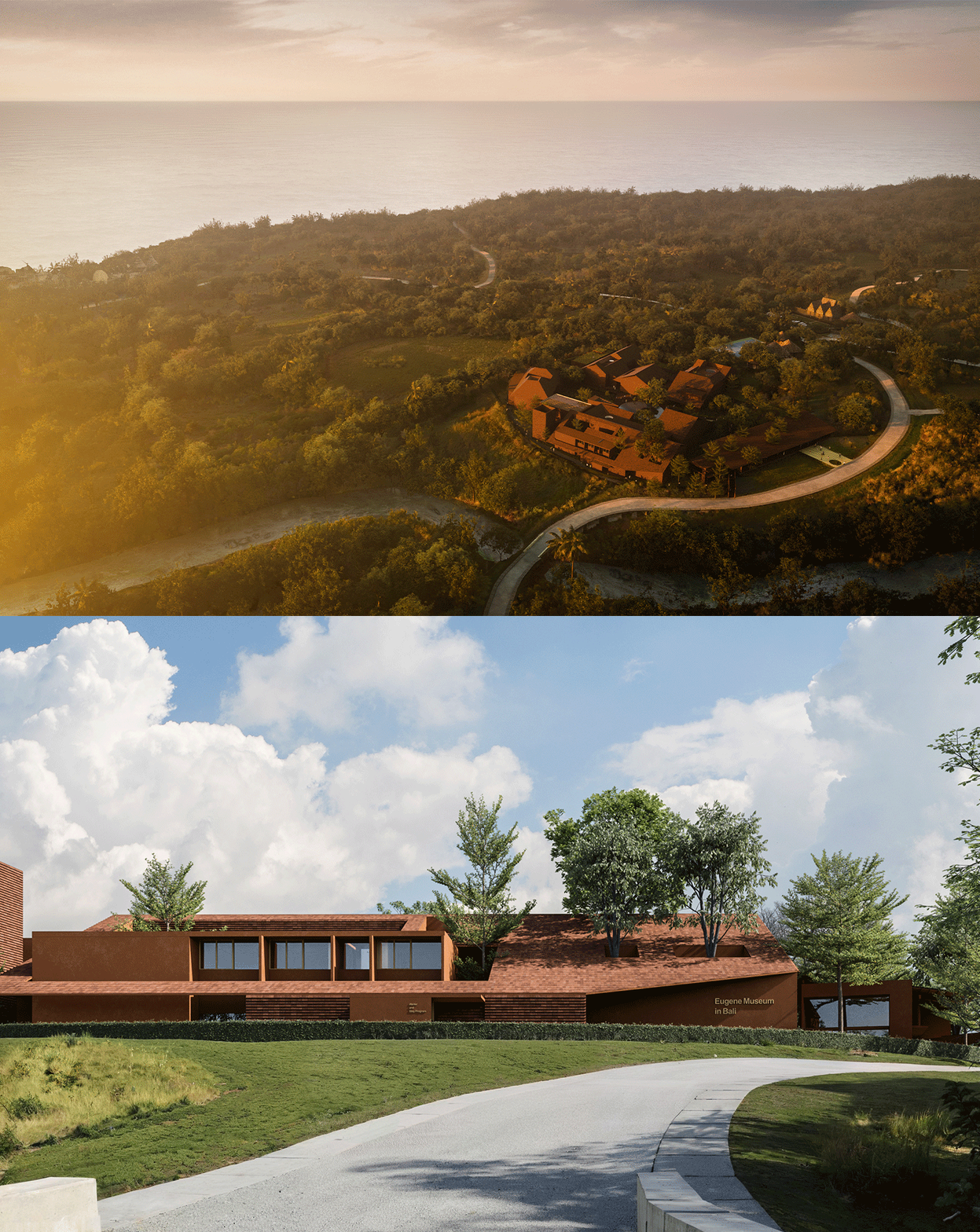
Through the vision, considerable efforts, and direct involvement of collectors connected to Asia, the ASEAN region, and Indonesia, construction has begun on a permanent museum dedicated to the works of Eugene Kangawa / EUGENE STUDIO, based on his solo exhibition The New Sea / After the Rainbow at the Museum of Contemporary Art Tokyo (2021-22). Located at the foot of a UNESCO World Heritage area in Bali, the Eugene Museum in Bali will be situated on a one-hectare site with facilities totaling approximately 5,000 square meters. The main building is being designed in dialogue between Indonesia’s leading architect, Andra Matin, and Kangawa himself, and is scheduled to open to the public in 2026.
We wish to express our heartfelt gratitude to all who proposed ideas beyond anything we could have imagined and dedicated themselves to making this permanent museum a reality.
Last November, preparation room for museum was opened in the capital, Jakarta, and the project was announced in Indonesia at the end of May this year. The architectural part of the museum, set on a 1-hectare site surrounded by the sea and greenery, is being designed by Andra Matin, a prominent Indonesian architect who won the Aga Khan Award for Architecture in 2022. The entire architecture is being developed to integrate seamlessly with the Eugene’s works. The Eugene Museum in Bali has been mentioned in Indonesia, as well as in the main editions of the Financial Times (UK) and Le Quotidien de l’Art (France).
Although there are still several years until the opening, we hope that this museum, situated in a wonderful town rich in greenery at the foot of a World Heritage site, will be open to children and various generations. For detailed information and comments from Eugene Kangawa, please refer to the museum’s operational website below.
*The construction, operation, legal affairs, public relations and all related activities of this museum are carried out by a local joint venture under local laws. The surrounding region and the entire area are supported mainly by local people, public office, and a multinational team from over 50 countries. Eugene Studio is responsible for overseeing the artworks in the museum.
Outline (Eugene Museum in Bali official website *external site)
Outline (Quoting from the Eugene Museum official website *external site)
“Located ten minutes from the famous Tanah Lot Temple, at the base of a UNESCO World Heritage site, the Eugene Museum in Bali is a permanent museum set amidst lush greenery and the ocean, established with various communities from around the world. The museum’s architectural design, by Indonesia’s renowned architect Andra Matin, features permanent artworks by Eugene Kangawa / EUGENE STUDIO (hereafter referred to as Eugene), blending seamlessly with nature, art, and architecture. Visitors can deeply experience this harmony on the museum’s 1 ha site, which is set to open to the public in 2026.
The 5,000 m² museum, designed to weave through the existing trees, will feature over ten rooms showcasing artworks such as Golden Rain, Infinite Ocean, and large, luminous paintings. The museum will also include a restaurant, library, and stay programs, offering a space where visitors of all generations can immerse themselves in deep, enriching experiences day and night.
Eugene’s paintings and large-scale installations, which explore themes such as love and chance, light and shadow, and nature or meta-nature, resonate with people navigating the complexities of contemporary life. Notably, Eugene’s solo exhibition at the Museum of Contemporary Art Tokyo in 2021-22—where he became the youngest artist to hold a solo exhibition—drew long queques despite being held during the COVID-19 pandemic. The impact of this exhibition reverberated globally, reaching diverse communities, including in Indonesia. With the strong support and expectations of communities who believe his artworks should be permanently exhibited and accessible to all generations worldwide, the Eugene Museum in Bali was established in the naturally rich and internationally vibrant setting of Bali.
Adjacent to the museum is an international school, poised to become a new hub from Asia, offering educational programs developed in collaboration with neighboring countries.
At the Eugene Museum in Bali, Eugene’s experiential works, which integrate nature, physics, and philosophy, will harmonize with the region’s rich natural beauty, and are anticipated to create a space where nature, art, and visitors coexist in harmony.
*The museum, which provides beautiful and truly astonishing experience, will feature approximately 15+ permanent installations, including Eugene’s signature installations, ‘Sea Garden,’ ‘Goldrain,’ and ‘Everything Shines,’ which reflect his enduring theme of symbiosis. The museum is managed by a joint management team of the museum and the area.
*In late-2023, in preparation for the museum development, a preparatory room was established in Jakarta, housed within the same building as the HQ of Art Jakarta.
*As “Cultural Landscape of Bali Province: the Subak System as a Manifestation of the Tri Hita Karana Philosophy”
For more details
For more articles
Press enquiries on this matter
Correspondence
Indonesia / Vivin
UK, US, FR / Sutton
The construction of the art museum, which is set to commence within the year, will be situated in Tabanan Regency, a wonderful area adjacent to the international school that opened last year, and is envisioned as the concept of a next-generation society. As an open museum, it is expected to collaborate with the local community to create a new way of life, born out of the resonance between Kangawa’s works and the surrounding area.
The architecture of the museum, surrounded by the sea and greenery, is being designed by Andra Matin, an award-winning architect of Indonesia who received the Aga Khan Award for Architecture, and is progressed in such a way that the entire building is a work of art.
This museum is a continuation of the ‘New Sea’ of Eugene Kangawa / Eugene Studio, as well as a permanent museum for children and all generations, a slightly new form of museum and a place for social practice.
We express our gratitude to those who have supported and proposed this project both domestically and internationally, especially individuals from Indonesia and the APEC region. Meanwhile, at the studio, we are working towards the scheduled public opening approximately two years from now. This involves the daily creation of artworks, comprising over 15 series, including both past and new pieces.
The museum will include several new works as well as paintings and installations, including ‘Critical’, ‘Goldrain’, ‘Light and Shadow inside me’ and ‘Everything Shines’.
Comment from Eugene Kangawa
“First and foremost, I am sincerely grateful for this wonderful opportunity in such a truly beautiful place as Bali, Indonesia, at the foot of a World Heritage Site. Visiting Indonesia and engaging with friends there has been a true joy. I would like to thank the people who have said they wanted to make it a permanent museum, and those who committed to the realization.
This museum will be open to all generations. It is a great honor for me to see my works and solo exhibitions go beyond the framework of a touring exhibition and become a permanent museum.
It is an important place in Indonesia, and I hope that we can carefully nurture it with the people around us.There are still a few years to go before the museum opens, and I look forward to its completion as we receive architectural drawings and landscape developments on a daily basis.
The Asia I have lived in is becoming increasingly sophisticated. When I first visited this new city, I strongly felt by both the splendor and weight of what the world of the future needs. I can say that the whole city’s approach and what I and we have been doing occurred naturally at the same era.
A few years ago, I became interested in understanding the language of Bahasa Indonesia, and I came across the word “Nusantara”. The word means “archipelago”. The appearance of being together, even if there are contradictions, a true symbiosis. In fact, the world is also an archipelago. I am going to take time for a deeper understanding of this word in the future.
I have always been interested in the history of Asia, upon receiving this opportunity. Bali felt familiar, both as an environment and as a geographical location. This evergreen place, visited by a wide variety of people, is geographically one of the centers of the world.
In 2016, I held an exhibition of the potential of a cityscape with low-rise buildings and an agriculture-centered city model. When I visited this area, it felt similar to the image I had envisioned at that time.
Reflecting often on the distance between art, society, life, and daily living, upon receiving this opportunity, I felt a new way of connecting them. From solo exhibitions in museums and experiences in self-built atelier, I believe there are still entirely new possibilities for art and the future direction of society, much like the vast ocean that lies ahead.
I believe that one of the fundamental roles of contemporary art is to freely embody the systems and ecologies that the world needs, without being constrained by stereotypes or market demands. The world has not been improved by technology and business alone. Both philosophy and real places are needed. If even one person who visits can have the opportunity to reflect on something, it might lead to changing the world.”
Comment from Andra Matin
“There are similarities between Eugene’s works and mine which includes our admiration to the sun, breeze and shadow.Visioning the museum to be accessible by everyone, I believe the space can be a subtle palette to the beautiful artworks created by Eugene.
The primary focus for Eugene Museum in Bali is to capture Bali’s tradition, culture, and soul, and blend them organically with Eugene’s artworks. My architectural approach is deeply rooted in a respect for nature, and I feel a strong affinity with Eugene’s works.This project delicately blends art, human behavior, and nature, incorporating elements that are deeply significant to cosmology.
In Bali, there is a traditional residential system known as the Natah system, which creates shared spaces for relaxation and builds a community around them. In this project, the shared space will serve as a collaboration between architecture, nature, Eugene’s artwork, and the visitors. Building on this system, we will make the most of local materials and techniques.
I hope this museum will become a destination for experiencing exceptional contemporary art and architecture in Indonesia. An Indonesian architectural team and a Japanese contemporary artist are joining forces to create immersive spaces and experiences through exceptionally delicate techniques. I hope that people in Indonesia and around the world will have the opportunity to experience this unique creation.”